

"I want to be able to defend myself!"
"I'd like to improve my mental focus!"
"I want to get in shape!"
Iaido
Secrets of Swordsmanship
If you like the Last Samurai, The Seven Samurai, 47 Ronin, or Samurai Assassin, you will love the art of Iaido!
In the Last Samurai, Captain Algren had to leave the world he knew to overcome his alcoholism and harden his spirit in the forge of swordsmanship. In the end, he not only found his spiritual center, he found the love and loyalty of an extraordinary clan of people steeped in the Japanese culture of Bushido.
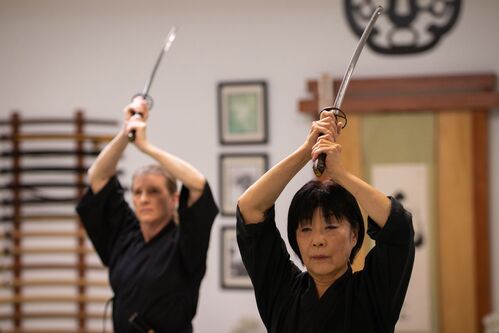
You can embark on a spiritual journey of your own. In a world where values such as honor, integrity and true wisdom are rare, the heart of Bushido still beats within the ancient art of iaido (pronounced ee-eye-dough). You can learn how to properly handle the katana while you hone your concentration, perception and personal presence. In the dojo, you can leave adversity behind and find your center through seishin tanren (concentrated practice). Cut through to the heart of your existence and you will emerge a stronger, deeper version of yourself.
Our Sensei, Nicklaus Suino, competing against hundreds of Japanese in their native art of Iaido, was All Tokyo Champion for four consecutive years between 1989 and 1992. He’s written four books on Japanese martial arts and consults internationally on strategies for personal and professional growth using the principles of swordsmanship. With little fanfare, he offers the profound spiritual path of Iaido to his students in Ann Arbor, Michigan, at a tiny fraction of the cost of his professional seminars.
Don’t wait to embark on your personal journey to enlightenment. Come see the extraordinary training that can help rocket YOU to success! Intro lessons are free. You have nothing to lose, and EVERYTHING to gain.
An excerpt from Suino-Sensei’s popular book Budo Mind and Body:
The Skill of the Masters
After a hard day of martial arts practice, while enjoying a cold drink with training partners, we sometimes share stories of the masters of old. These are stories of men and women who were able to perform feats of martial skill that seem almost magical to us today. The stories are an inspiration to train harder, and they hint at what might be possible if we keep practicing long enough. The images are so compelling that whole systems of study have grown up around certain masters, men like Ueshiba Morihei, the founder of aikido, who was said to be able to throw his students to the ground with the strength of a single finger. Ueshiba could casually drop two, three, or even ten attackers. At the same time, there was more to the old master than mere physical skill. Considered as enlightened man, Ueshiba was known for such sayings as "Love is the highest principle of the martial arts," and "To injure an opponent is to injure yourself."
According to the stories, there was always something about these masters that resonated beyond their great skill. Mifune Kyuzo, perhaps the greatest technician ever to come out of the Kodokan (the original judo institution), was known for the softness of his techniques. He was able to defeat students twice his size while barely seeming to expend any effort. People who trained with him later said, "It was like fighting with an empty jacket." Mifune was a great historian of the martial arts, and developed theories of physical interaction that are still studied by judoists.
There have been swordsmen in Japan's samurai history who reached a point in their training where they were able to say, "I cannot be defeated by anyone in the world." The legendary Miyamoto Musashi and Yamaoka Tesshu each reportedly made this claim - in different eras, of course - and nobody was ever able to prove them wrong. Other swordsmen who engaged these men would face them and be unable to detect any opening for an attack. Both men were great artists with a brush, and Yamaoka was a preeminent statesman.
A similar story is told about a martial artist named Matsumura Sokon, one of the pioneers of Okinawan karate. A skilled opponent, determined to fight him, tried three times to mount an attack, but each time was driven back by the sheer physical energy emanating from Matsumura. The actual physical battle never took place because Matsumura's challenger was unable to gather himself to strike.
It would be easy to dismiss these stories as legends, exaggerated by the admiration of students for their teachers and by the passage of time, had I not witnessed similar feats by living martial arts masters. These were not the kind of tricks you see when you watch a martial arts movie; any well-motivated and talented athlete could learn the spinning kicks and flips you see on film. The feats I saw were impressive not so much as physical skills, although such skills do require years of practice to master, but as reflections of inner strength. If you saw these masters in action, you wouldn't necessarily be impressed by a show of great physical strength. Instead, their proficiency and presence would cause you to think that something profound was taking place before you.
One living example of such modern masters is a man named Sato Shizuya, a judo and jujutsu teacher. Like his own teacher, Mifune Kyuzo, Mr. Sato has an uncanny ability to throw his students around the mat like rag dolls. Further, when he does it, he is relaxed, apparently thinking about something else. I know that he hardly uses any physical strength because he used to toss me around when I trained with him in Japan. I was thirty years old at the time, and he was around sixty-two; this was over fourteen years ago, and he is still a source of great energy and wisdom.
Another of my teachers, Yamaguchi Katsuo, is a swordsman known around the world in martial arts circles. He underwent treatment for stomach cancer in 1993, and is very elderly now, but between 1988 and 1992, watching him perform formal exercises with the sword was an almost religious experience. During demonstrations in Japan, hundreds of swordsmen and women will perform in groups of four or five at a time, and the audience often loses interest after an hour or two, even when watching some of the most famous swordsmen in the country. When Yamaguchi-Sensei began his sword cuts, however, everyone was rapt. A calm would fall over the audience and the air would become charged with a feeling of reverence - and these were people quite used to seeing swordsmanship demonstrations.
* Note: both Sato-Sensei and Yamaguchi-Sensei have passed away since this was written. The world of budo will miss these two extraordinary men.